
Hier findet der geschätzte Leser, eventuell bisweilen erneuert, die aktuelle Fassung meiner Arbeit zum oben genannten Titel.
== “ ==
Anmerkung zu den US-Militärbasen am Golf von Persien:
1. Bahrain:
(Iden des März, 2026, 1407.)
Am 23. Dezember 1971, mithin an ein und demselben Tag (!), erfolgte zwischen dem US-amerikanischen Chargé d’Affaires ad interim in Manama, Bahrain, John N. GATCH, Jr., und dem Bahrainischen Außenminister, MOHAMMAD BIN MUBARAK AL-KHALIFA, ein diplomatischer Notenwechsel1, constituting an agreement to maintain deployment inBahrain of the United States Middle East Force, including its flagshipand other vessels and aircraft, dessen einleitende Worte, in Note I der US-Seite, lauten wie folgt:
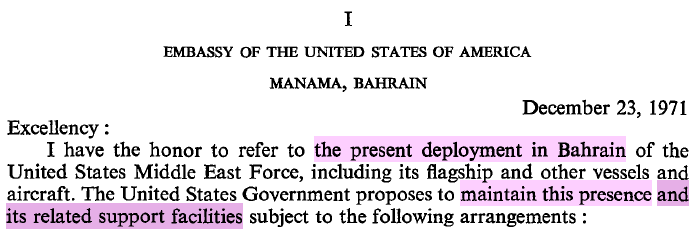
Daraus geht hervor, dass die vertragsgegenständlichen militärischen Einrichtungen in Bahrain zum Zeitpunkt des Notenwechsels bereits existierten. Damit ist klar, dass es um die Freiwilligkeit einer Zustimmung dazu seitens der Bahrainischen Regierung nicht sehr weit her gewesen sein kann.
Außerdem zitiere ich aus einem Memorandum über ein Gespräch am 11. März 1969, zwischen Vertretern des Vereinigten Königreichs und der USA,2 auszugsweise wie folgt:
Mr. Arthur (UK) then said that the important thing to remember about the Persian Gulf is that it is the dividing line between the Persians and the Arabs. The British have been there in some force for 100 years and have, in effect, frozen the situation at minimum cost. By the end of 1971 the British will have gone and there will be a serious danger of a confrontation between the Arabs and the Iranians. The main problem lies not on the mainlands of either side but is represented by the islands in the Gulf—Bahrain and the other smaller islands. Mr. Arthur said that if we can settle the problem of Bahrain, we can avoid a confrontation between the Arabs and the Iranians that could prove disastrous. Also, if we can settle the Bahrain question, the question of the other islands would be much easier to dispose of. The main British aim is to do what we can to avoid an Arab/Persian confrontation3. The British believe the Soviets will not be able to penetrate the Gulf effectively if the Bahrain question is solved, because such a solution would foster Iranian cooperation with the Arab side and this cooperation would be an effective block to Soviet efforts. Otherwise, the Soviets would be able to play both sides of the Gulf and undoubtedly would be able to establish a position of some influence on the Arab side.
Mr. Sisco (US) asked what the British can do to ensure that a settlement of Bahrain is reached prior to 1972. Mr. Arthur replied that the UK could not “produce” either side. He noted the Shah’s previous insistence on a plebiscite and British and Bahraini views of the dangers of a plebiscite. Mr. Sisco asked how a plebiscite would come out. Mr. Arthur said that perhaps a bit of background was necessary here. He said that the Shah does not really want Bahrain—it has a stagnant economy with small and diminishing oil resources. But the Shah regards Bahrain as a “jewel in his crown,” and he doesn’t feel he can give it up unless a way is found to save Iranian face. His first thought had been a plebiscite in which Bahrainis were simply asked whether they wanted to be a part of Iran or not. The British had discussed this with the Bahrainis who rejected it, as indeed had the Kuwaitis and as indeed would all Arabs. This rejection is based on both formal and practical grounds. The formal grounds are that, for the Ruler of Bahrain to allow a plebiscite, would be to admit that the Iranian claim had some validity. The practical grounds are that the social fabric of Bahrain is very fragile, made up as it is of about half Sunni and half Shia Moslems, between whom feeling often runs high. To hold a plebiscite would undoubtedly cause serious intercommunal disturbances in Bahrain. Moreover, Bahrain has never had any representative body in its history. A serious security situation could arise if a plebiscite were held. Added to this is the fact that the al-Khalifa ruling family is not basically strong.
Ich enthalte mich vorerst eines weiteren Kommentars zu diesen Begehrlichkeiten und Schachereien.4
1513
Dem oben erörterten Notenwechsel vom 23. Dezember 1971 gingen die im Folgenden, grosso modo, dargestellten Vorgänge um die Erlangung der sog. Unabhängigkeit Bahrains von seinem Protektor, dem Vereinigten Königreich, voraus, welche sich hingegen an die oben auszugsweise zitierte Abrede aus 1969 anschloss:
Laut OP7 eines Telegram From the Commander-in-Chief, Strike Command
(Throckmorton) to the Joint Chiefs of Staff, vom 18. November 19705, der da lautet:
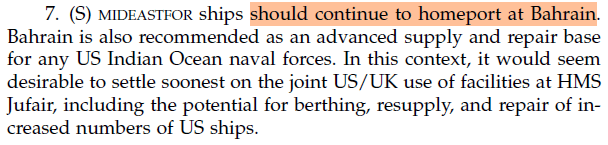
waren die USA mit ihrer Marine bereits zu diesem Zeitpunkt in Bahrain als deren Heimathafen präsent.
Erst am 15. August 1971 erklärte Bahrain seine Unabhängigkeit und schloss einen Freundschaftsvertrag6 mit dem UK ab. Am selben Tag erklärte Bahrain außerdem, die Pflichten aus der UN-Charta befolgen zu wollen, was es mit einem Antrag nach Artikel 4 UN-Charta auf Aufnahme als Mitglied verband. Ungewöhnlicherweise wurde diese Erklärung am 17. September 1971 vom UNSG ex officio in den UNTS7 veröffentlicht, was auf deren ganz besondere Bedeutung für den Weltfrieden hinweist.
1743
Desgleichen vom 15. August 1971 datiert der Exchange of notes constituting an agreement concerning the termination of special treaty relations between the United Kingdom and Bahrain and its dependencies,8 der wie folgt lautet:
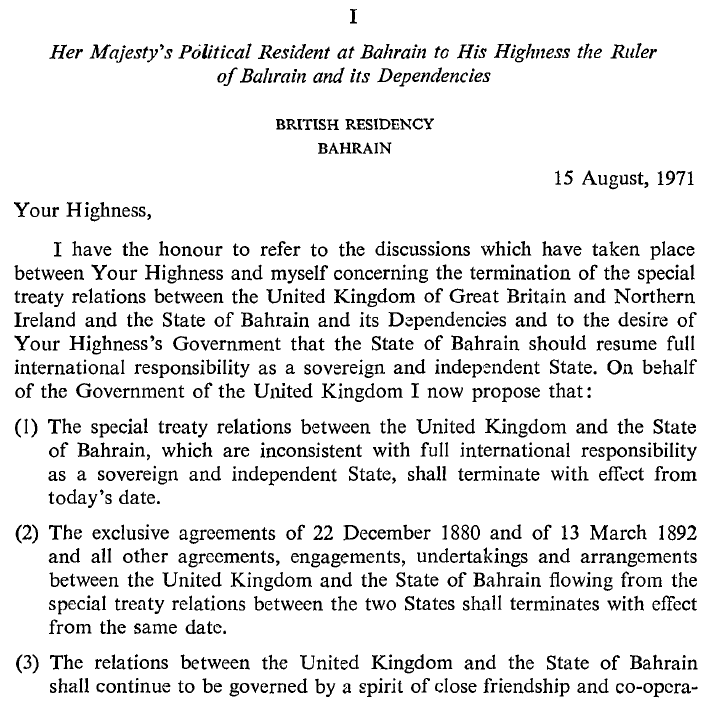
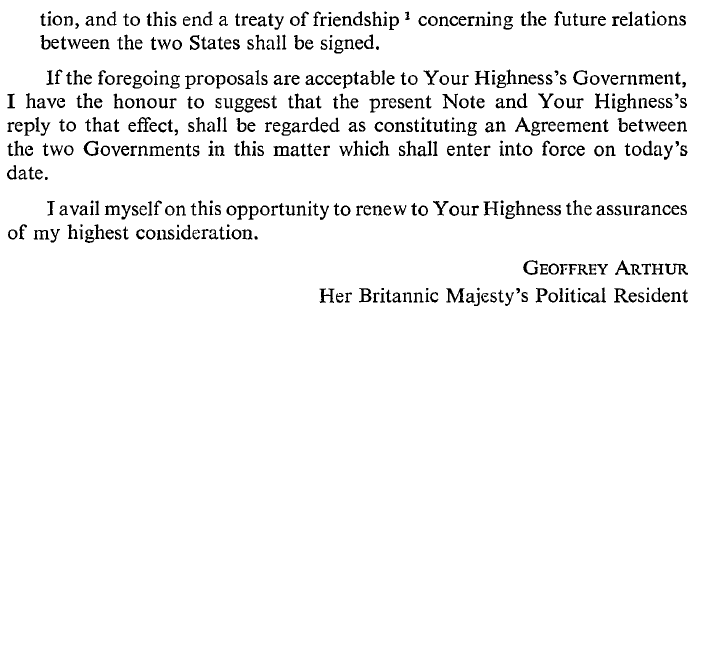
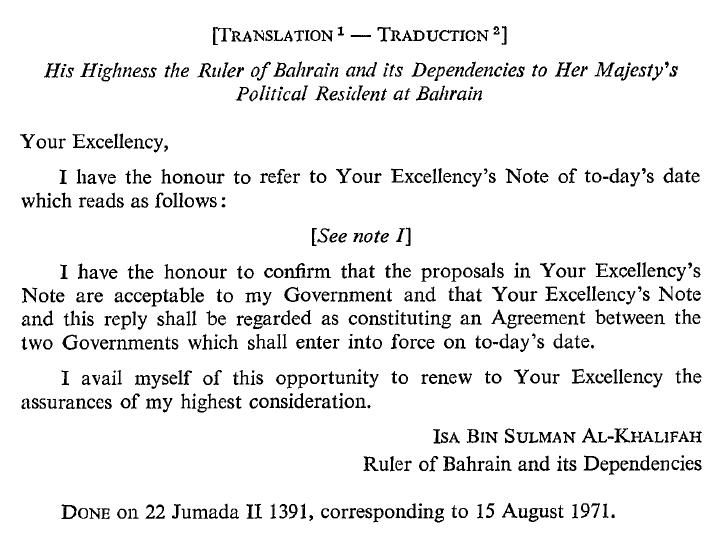
Die in diesem Notenwechsel, seinem Teil I, Absatz (2), genannten Abkommen über Ausschließlichkeit aus 18809 bzw. 189210 lauten (in chronologischer Reihenfolge:
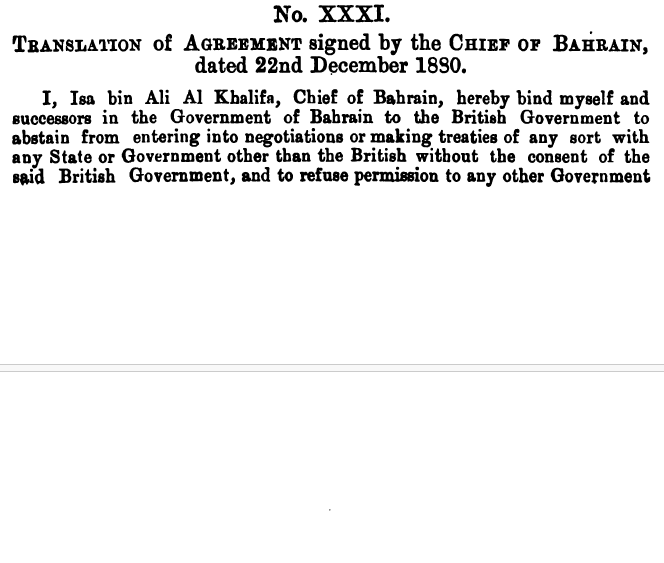
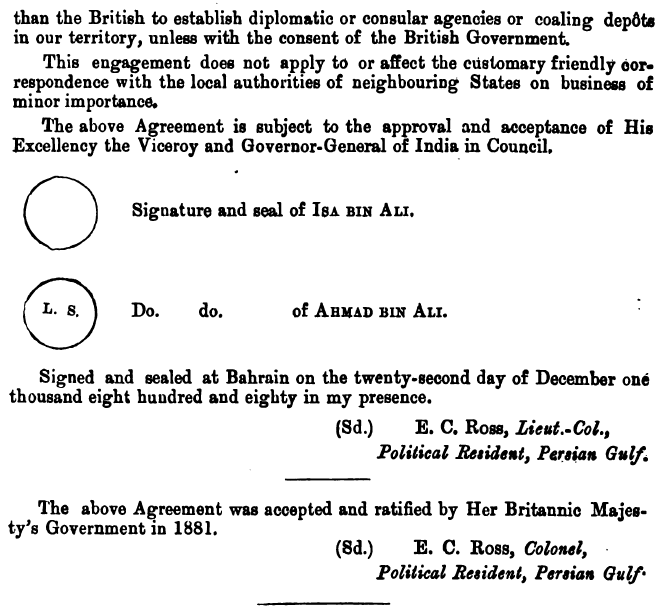
sowie
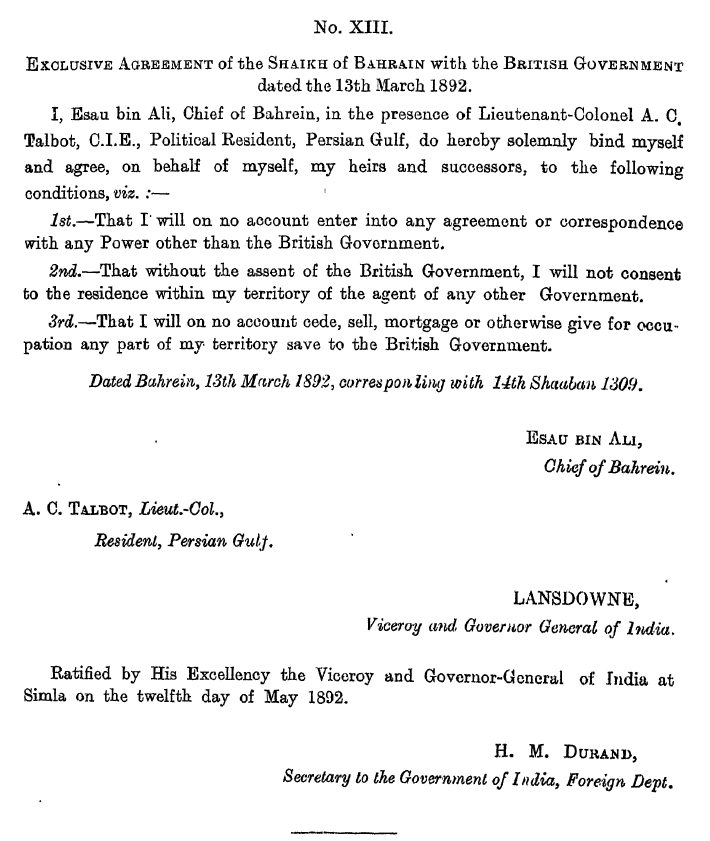
Die darin vereinbarten Verpflichtungen Bahrains zur Ausschließlichkeit seiner Beziehungen zugunsten UK, welche nach damaligem Völkerrecht üblich waren, machen die offenbar 1969/70 faktisch begonnene militärische Präsenz der USA in Bahrain nichtig, woran der im Dezember 1971 ausgetauschte Notenwechsel nichts mehr ändern kann, weil die bedrohliche Macht des Faktischen der Bahrainischen Regierung deren freien Willen nahm; wobei angesichts dessen, worum es dem Westen wirtschaftlich ging, davon auszugehen ist, dass von dieser Bedrohlichkeit seitens der USA auch Gebrauch gemacht wurde.
Angesichts der Daten dieser verschiedenen Völkerrechtsinstrumente, welche teils aneinander anschließen, bzw. die faktische Abfolge des Einschleichens der USA spiegeln, belegt, dass man sich der rechtlichen Zusammenhänge bzw. Folgen sehr wohl bewusst war, was erneut auf die Absicht des Einläutens einer Transitionsphase hinweist.
1846
Zuletzt ist noch auf die eigentümliche Formulierung im Freundschaftsvertrag hinzuweisen, die im nachfolgenden Auszug dessen Präambel lila-orange markiert ist:
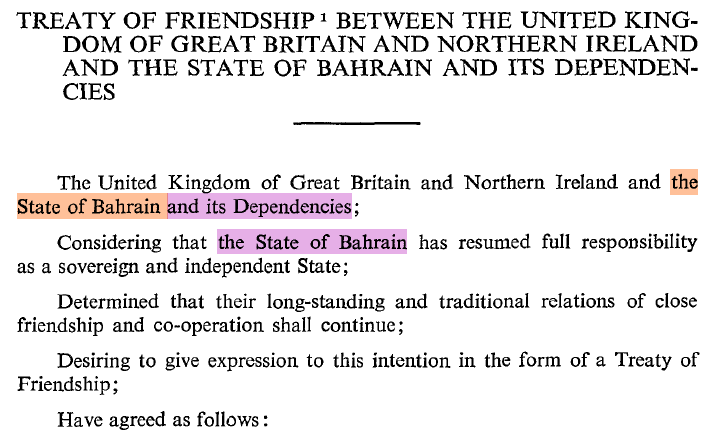
Dass der Zusatz and its Dependencies einmal vorhanden ist und einmal fehlt, bewirkt, dass das Mutterland und diese Dependenzien verschiedene rechtliche Schicksale haben können, wobei nicht gesagt wird, welches die letzteren sind. Zu denken ist aber an die Inseln, von denen im Memorandum aus 1969 (siehe oben) die Rede ist.
[wird fortgesetzt…]
- 823 UNTS 11801. ↩︎
- Office of the Historian, Bureau of Public Affairs, United States Department of State. Middle East Region and Arabian Peninsula, 1969–1972; Jordan, September 1970 (Foreign Relations of the United States, 1969–1976, Volume XXIV) (Kindle-Positionen 6232-6235). FRUS, 1969-1976, Volume XXIV, Doc. 72. ↩︎
- Bekanntlich sind Wiederholungen gleicher Inhalte selten gute Omen. ↩︎
- Siehe dazu aber meinen Beitrag hier, in diesem Blog, sowie meine Arbeit über den, und die Übersetzung des, omanisch-iranischen Vertrag(s) aus 1856! ↩︎
- Siehe FRUS (FN 2), Doc. 43! ↩︎
- 814 UNTS 11587. ↩︎
- 797 UNTS 11351. ↩︎
- 814 UNTS 11586. ↩︎
- AITCHISON, Collection of Treaties, Vol. X, Calcutta (1892), 120. ↩︎
- Ebd. (FN 9), Vol. XI, Delhi (1933), 238. ↩︎
 Arthur's Law Space